“You foolish boy.”
“You told me nobody would get hurt.”
Victor’s expression hardened.
“You were born with everything, and somehow you became weak.”
Wyatt shook his head.
“No.”
He looked at Nora’s attackers’ fathers.
“I just finally realized what you are.”
Ashford stepped toward me.
“The case.”
“First tell me something.”
He stopped.
“Why Nora?”
“You know why.”
“No. Rebecca had the ledger.”
“And Rebecca would never expose herself for you.”
His smile grew.
“But for her daughter?”
There was the truth.
They had attacked Nora to draw Rebecca out.
Not me.
I had never been the real target.
Nora was bait for her mother.
Ashford bent down and opened the silver briefcase.
Empty.
His face changed.
“You never had it.”
“No.”
“Then where is Rebecca?”
A woman’s voice came from the far end of the facility.
“Right here.”
I forgot how to breathe.
A figure stepped into the light.
Short brown hair streaked with gray.
Same eyes.
Same posture.
Thirteen years older.
But alive.
Rebecca.
My wife.
The woman I had mourned.
The woman Nora had grown up without.
She carried no weapon.
Only a thick black binder.
Ashford stared as though he had seen a ghost.
Rebecca looked at me.
For a moment, the entire world disappeared.
“I’m sorry, David.”
I couldn’t speak.
She turned toward Ashford.
“You wanted the ledger.”
She held up the binder.
“Here it is.”
Victor Holbrook stepped forward eagerly.
Rebecca smiled.
“You really haven’t learned anything.”
“What?”
“This isn’t the only copy.”
Red and blue lights suddenly illuminated every window.
Ashford spun around.
Federal agents entered from multiple doors.
“Federal agents! Hands where we can see them!”
Charles Kensington froze.
Senator Sterling shouted, “Do you have any idea who I am?”
An agent calmly answered:
“Yes, ma’am.”
Victor Holbrook looked at Rebecca.
“You set us up.”
“No,” she said.
“My daughter did.”
And that was the final twist none of them expected.
Nora had known her mother might come.
The message summoning me had been forwarded automatically from Wyatt’s missing phone because Nora had secretly installed a dead-man transfer system weeks earlier.
Rebecca received the same photograph.
The same location.
And before entering the facility, she delivered copies of the Black Lantern ledger to federal investigators, three major newspapers, an inspector general, and two independent oversight organizations.
Nothing could be deleted now.
Nothing could disappear.
For the first time, the families who had spent decades erasing evidence had nowhere left to hide.
PART 6 — WHAT SURVIVED
The arrests did not happen like they do in movies.
There was no dramatic final gunfight.
No explosion.
No revenge speech.
There were handcuffs.
Warrants.
Evidence boxes.
Lawyers.
Court filings.
And eventually, consequences.
Charles Kensington was charged in connection with bribery, obstruction, fraudulent contracting, and conspiracy.
His company collapsed after investigators uncovered years of fabricated invoices.
Senator Margaret Sterling resigned after financial records demonstrated that her political network had helped shield multiple criminal investigations.
Brantley Sterling was charged for Nora’s assault.
Chad Kensington was charged as well.
Neither family could make the case disappear anymore.
Victor Holbrook faced the largest investigation.
Aegis Meridian lost multiple government contracts while authorities examined fraudulent procurement, obstruction, witness intimidation, and the crimes connected to Black Lantern.
Colonel Raymond Ashford was arrested that night.
Detective Trent became a cooperating witness.
He lost his position.
He knew he would.
But he testified anyway.
Wyatt Holbrook also testified.
He never pretended to be innocent.
He admitted he had initially participated in intimidating Nora.
He admitted he knew his family used power to frighten people.
But when Chad and Brantley attacked her, he tried to stop them.
The prosecutors took that into account.
Nora did too.
She never called him a hero.
She simply said:
“He finally made one decent decision when it mattered.”
That sentence stayed with me.
Because people are rarely only one thing.
Coward.
Hero.
Victim.
Villain.
Sometimes the difference is the decision made when there is still time to choose.
But the hardest reckoning happened far from any courtroom.
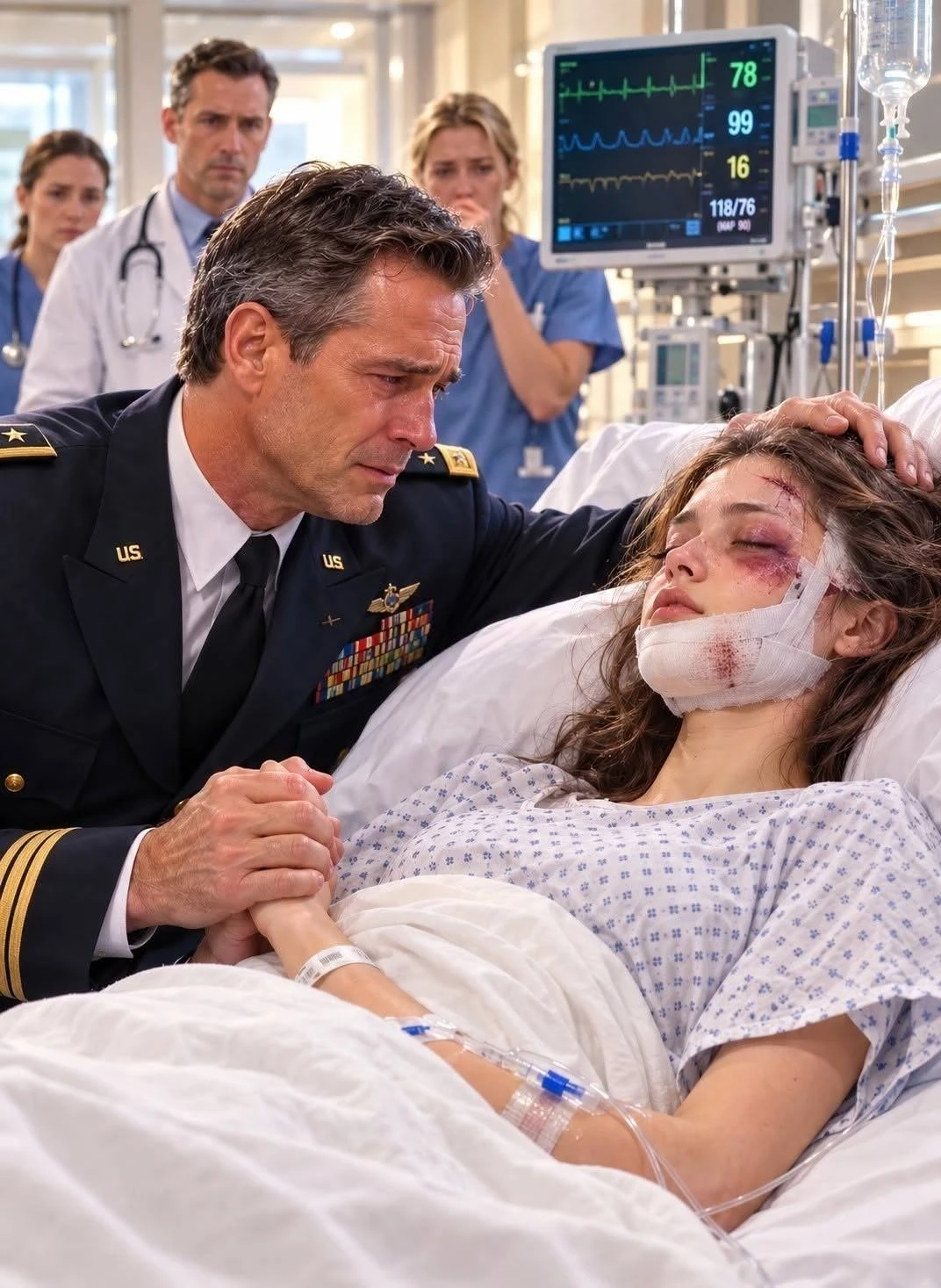
It happened in Nora’s recovery room.
Rebecca stood in the doorway.
Nora stared at her mother.
For several seconds, neither moved.
Then Nora began crying.
Rebecca crossed the room.
Nora held out one hand.
Her mother took it.
Thirteen missing years existed between them.
No explanation could erase them.
“I thought you were dead,” Nora whispered through her healing jaw.
Rebecca cried harder.
“I know.”
“I needed you.”
“I know.”
“Dad needed you.”
Rebecca looked toward me.
“I know.”
I wanted to hate her.
Part of me did.
But I also understood the impossible choice she had made.
Ashford had threatened Nora when she was six.
Rebecca discovered someone had photographed Nora outside her elementary school.
She knew staying meant turning our child into leverage.
So she created her own death.
Not because she stopped loving us.
Because she believed disappearing was the only way to keep Nora alive.
“Why didn’t you tell me?” I asked.
Rebecca looked at me.
“Because you would have come after them.”
“I would have protected you.”
“I know.”
“Then why?”
Her answer broke something inside me.
“Because you would have become the Phantom Commander again.”
Silence filled the room.
She stepped closer.
“And eventually, David, you would have died.”
I looked at Nora.
At Bishop.
At the old challenge coin sitting on the table beside her bed.
Rebecca had been right.
Nineteen years ago, I thought survival meant being harder than the people hunting you.
Nora taught me something different.
Survival meant leaving evidence.
Trusting people.
Building something stronger than fear.
Weeks passed.
Nora underwent several procedures and months of therapy.
Her doctors expected a strong recovery.
The first time she ate solid food again, she insisted on pizza.
It was terrible hospital cafeteria pizza.
She called it the best meal of her life.
Bishop laughed until tears filled his eyes.
Mitchell, Lawson, and Park visited constantly.
Nora began calling them “the ancient commandos.”
They pretended to be offended.
They loved it.
Rebecca did not simply return to our lives as though thirteen years had vanished.
There were arguments.
Long silences.
Questions without good answers.
Nora was angry.
I was angry.
Rebecca accepted that anger.
She never demanded forgiveness.
That mattered.
Healing turned out to be much slower than any military operation I had ever commanded.
There were no maps.
No objectives.
No victory conditions.
Just people learning how to trust each other again.
Six months later, Nora returned to the university.
She changed her major from journalism.
For approximately four days.
Then she changed it back.
When I asked why, she looked at me like I had asked the dumbest question imaginable.
“Dad, they shattered my jaw because they were afraid of what I was writing.”
She smiled.
“Obviously I’m going to keep writing.”
I laughed.
“That sounds dangerously like your mother.”
Rebecca, standing in the kitchen, answered:
“She gets the stubbornness from you.”
Nora’s investigation eventually won a national student journalism award.
She titled the series:
THE PEOPLE WHO THOUGHT THEY WERE INVISIBLE.
The first article did not begin with Chad Kensington.
Or Brantley Sterling.
Or Wyatt Holbrook.
It began with a sentence about power.
Power becomes dangerous when the people who possess it begin believing consequences belong only to everyone else.
The final article discussed Black Lantern.
Not the classified operational details.
Those remained protected.
Instead, Nora wrote about the people who had survived it.
Bishop.
Mitchell.
Lawson.
Park.
Rebecca.
And me.
She never used the name Phantom Commander.
I asked her why.
She shrugged.
“That wasn’t the person who saved me.”
“Who did?”
She looked at me.
“My dad.”
A year after the night at the hospital, I returned to the cemetery.
Rebecca came with me.
We stood beneath the oak tree in front of the grave I had visited for thirteen years.
The stone still carried her name.
REBECCA MILLER
BELOVED WIFE AND MOTHER
She stared at it for a long time.
“This is weird.”
“You think?”
She laughed quietly.
Then she began crying.
I took her hand.
“What should we do with it?” she asked.
I thought about everything the grave represented.
Grief.
Fear.
Protection.
Lies.
Love.
Survival.
“Leave it.”
She looked surprised.
“Why?”
“Because somebody died here.”
“Who?”
I reached into my pocket.
The black Vanguard challenge coin rested in my palm.
For years, the words had defined an identity I thought I had buried.
VANGUARD NEVER DIES.
I placed the coin against the base of the stone.
“The Phantom Commander.”
Rebecca looked at me.
“And you’re okay with that?”
I thought about Nora.
About the hospital.
About the phone call.
About four aging soldiers who answered after nineteen years without asking what they would receive in return.
About a detective who finally chose truth over fear.
About a privileged young man who realized too late what his family had become but still chose to stop running.
About a woman who had sacrificed thirteen years of her own life to protect her child.
And about my daughter, who had refused to surrender even when powerful people promised they could erase her.
“Yes,” I said.
“I am.”
Rebecca squeezed my hand.
We walked away from the grave together.
When we reached the cemetery gate, my phone vibrated.
A message from Nora.
Dinner at seven. Don’t be late. Mom is cooking, so maybe bring emergency food.
Rebecca glanced at the screen.
“I saw that.”
“I didn’t say anything.”
“You were thinking it.”
“Military training.”
She rolled her eyes.
For the first time in a very long time, the future felt ordinary.
And ordinary was beautiful.
Behind us, beneath the oak tree, the challenge coin caught the afternoon sun.
For decades, powerful men had believed Vanguard was something they could destroy.
They misunderstood what Vanguard had always been.
It was never a unit.
Never a classified file.
Never a commander whose name officially did not exist.
It was a promise.
If one person fell, another stood.
If evidence disappeared, someone kept a copy.
If fear silenced one voice, another spoke louder.
And if powerful men believed money could make the truth disappear forever, eventually they learned the lesson Chad Kensington, Brantley Sterling, Victor Holbrook, and Raymond Ashford learned too late.
Money can buy silence.
Influence can delay justice.
Connections can hide the truth for years.
But none of them can erase the truth once enough people refuse to look away.
They shattered my daughter’s jaw because they believed she was powerless.
Instead, they awakened the very people their families had spent nineteen years trying to bury.
And in the end, the Phantom Commander never needed to return.
Because a wounded nineteen-year-old girl with a hidden phone accomplished something the legendary commander never could.
She brought the entire empire down without firing a single shot.
The End
See more on the next page