The first thing I heard after the crash was metal screaming.
The second was my mother telling me that pickleball mattered more than my children.
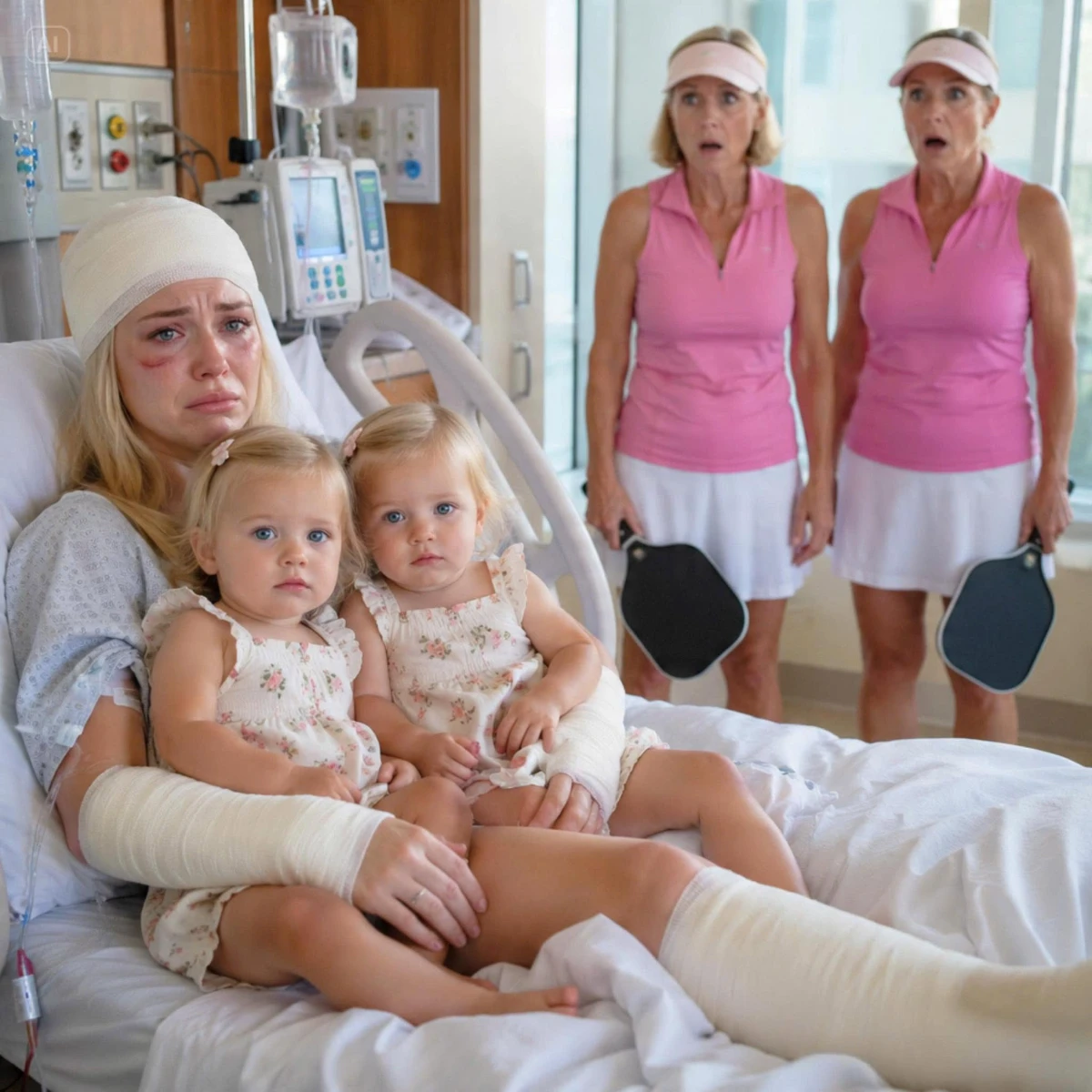
I woke beneath white hospital lights with a fractured pelvis, two shattered ribs, a concussion, and a surgeon standing over me with the careful expression doctors wear when they are trying not to frighten you.
“Elena, the surgery went well,” he said. “But recovery will be measured in months, not weeks.”
Months.
My mind did not go to my legs.
It went immediately to Leo and Maya.
“My babies?”
“Safe.”
The word broke me open.
My one-year-old twins had been strapped into rear-facing car seats when a delivery truck ran a red light and slammed into the driver’s side of my SUV. Their seats had done exactly what they were designed to do.
A few bruises.
A frightened night.
No serious injuries.
I had never been more grateful for anything in my life.
My husband, Adrian, had died from an aneurysm eleven months earlier. Since then, every major decision had belonged to me alone. Every fever. Every midnight cry. Every grocery run. Every daycare pickup. Every moment when two tiny people reached out at the same time and called me Mama.
There was no second parent to call.
And now I could barely lift my head.
A social worker explained that the hospital could arrange emergency childcare only temporarily.
Twenty-four hours.
Maybe forty-eight if she begged.
After that, I needed family, a private caregiver, or emergency foster placement until I could arrange something permanent.
The word foster made panic tear through me.
“No,” I whispered. “I have family.”
I believed it when I said it.
That was the worst part.
My father, Howard, had retired five years earlier. My mother, Beatrice, had never worked outside the home after my sister and I were born. They lived twenty-three minutes from the hospital.
My sister Seraphina lived seven minutes beyond them.
I called my mother first.
She answered on the sixth ring.
“Elena? I’m heading out.”
“Mom.”
Something in my voice must have registered because she stopped rustling around.
“What happened?”
“I was in an accident.”
A pause.
“How bad?”
“I had surgery.”
Another pause.
Not Are you okay?
Not Where are the twins?
Just, “What kind of accident?”
I swallowed against the dryness in my throat.
“The SUV got hit. Leo and Maya are okay. I’m not.”
My voice cracked.
“I need you and Dad to take the twins for a few weeks. Maybe longer. Until I can stand and—”
She sighed.
It was a long, irritated exhale.
The kind people make when the waiter says the kitchen forgot their side dish.
“Elena, this is really terrible timing.”
I stared at the ceiling.
“What?”
“I have my league.”
For a second, I genuinely thought the medication was making me hallucinate.
“What league?”
“My pickleball league.”
I said nothing.
She continued, almost defensive now.
“I still need time for pickleball. Your father has golf twice a week. We have our lives too, you know.”
“Mom, I was almost killed.”
“And we’re sorry about that.”
Sorry.
As if she had forgotten my birthday.
“Mom, they’re one year old.”
“Yes, exactly. They need constant supervision.”
My hand tightened around the phone until pain shot through my wrist.
“I can hire daytime help. I just need them somewhere safe. Somewhere familiar.”
“We are not built-in babysitters, Elena.”
I felt something inside me crack that no surgeon could repair.
“Please.”
I almost never begged.
I had negotiated seven-figure acquisitions without trembling.
I had fired executives twice my age.
I had buried my husband while holding two eleven-week-old babies.
But lying in that hospital bed, unable to move my hips without seeing white sparks, I begged my mother.
“Please, Mom. I need you.”
She lowered her voice.
“You always need something.”
That sentence hurt more than the crash.
Then came the one that changed my life.
“Your sister never bothers us the way you do.”
I closed my eyes.
Seraphina.
Of course.
“Mom—”
“I have to go. Figure it out.”
Then she hung up.
For several seconds, the phone remained pressed against my ear.
Nothing moved except the IV fluid dripping beside me.
Drip.
Drip.
Drip.
Outside the glass wall of my room, Maya began crying.
I recognized her cry instantly.
Not hungry.
Not tired.
Scared.
I tried to sit up.
Pain ripped through my pelvis so violently that I screamed.
May you like
- This Powder Cannot Wipe Away Cataracts in Two Minutes: What You Should Know About Cloudy Vision
- A Natural Aloe Vera and Lemon Recipe? What You Should Know About Eye Health and Cancer
- Do You Eat Raw Garlic Before Bed? Here’s What It May Really Do
- Drink This Tomato-Based Juice for 3 Days? What It Can Really Do for Your Health
- Can a Natural Remedy Really Dissolve Cataracts in 30 Minutes?
A nurse hurried in.
“Don’t move.”
“My daughter.”
“We have her.”
“I need her.”
“Elena, you cannot lift her.”
“I’m her mother.”
“I know.”
That almost destroyed me.
The nurse’s name was Clara Morales. She was in her fifties, with silver threaded through dark hair and the calm hands of someone who had seen people receive the worst news of their lives.
She helped reposition me.
Through the glass, I could see Leo asleep in a portable crib and Maya being rocked by an aide.
My babies were close enough to see.
Too far to touch.
And suddenly, as I watched them, every payment I had ever made for my parents marched through my mind.
Their mortgage.
Their property taxes.
Their Lexus.
My father’s supplemental health insurance.
My mother’s country club membership.
Golf dues.
Pickleball dues.
Two vacations a year.
The roof replacement.
The kitchen renovation.
A thirty-eight-thousand-dollar emergency when my father invested in a restaurant that failed.
The eighty-seven thousand dollars Seraphina borrowed to open a boutique she abandoned after eleven months.
Her car.
Her rent.
Her “consulting salary” from my company despite the fact that she had never consulted on anything more complicated than where to order lunch.
For eight years, I had been the family bank.
And I had told myself it was love.
Clara picked my phone off the blanket before it slid onto the floor.
“Who can I call?”
I turned my eyes toward her.
There is a strange kind of clarity that comes when humiliation finally outruns hope.
Something inside me became very still.
“Daniel Cho.”
“Who is that?”
“My attorney.”
She handed the phone back.
I called.
Daniel answered on the first ring.
“Elena?”
His voice sharpened immediately.
“What happened?”
I told him.
The crash.
The surgery.
The twins.
My mother.
All of it.
When I finished, he was silent.
Daniel had been my attorney for nine years. He had known Adrian. He knew my parents. He knew every trust, company, asset, and recurring family payment because he had repeatedly warned me about them.
“Elena,” he said carefully, “what do you want me to do?”
I stared at the ceiling.
“I want every family payment stopped tonight.”
Another silence.
“Define every.”
“Cards. Insurance premiums I’m covering. Club memberships. Vehicle leases. Seraphina’s payroll. Vacation accounts. Household account. Everything.”
“Your parents’ residence?”
That was the one.
My parents called the house theirs.
It was a five-bedroom stone home overlooking a golf course.
But they did not own it.
They had never qualified for the financing.
My holding company had purchased it six years earlier.
I paid the taxes, insurance, maintenance, landscaping, utilities, and homeowners association fees.
They lived there under a renewable occupancy agreement charging one dollar annually.
Daniel had insisted on the agreement.
At the time, I had accused him of being cynical.
Now I understood he had been protecting me from my own desperation to be loved.
“Yes,” I said.
Daniel exhaled.
“Elena, if I terminate the occupancy agreement, they have ninety days under the contract.”
“Do it.”
“They’ll panic.”
I looked toward the glass wall.
Maya had stopped crying.
The aide rocked her gently.
“They should have thought of that before abandoning two babies.”
Daniel waited.
“Are you sure this isn’t the morphine talking?”
I almost laughed.
“No.”
Then I said the sentence that made everything permanent.
“I’m done purchasing affection from people who would leave my children with strangers so they can play pickleball.”
“All right.”
I heard his keyboard.
“Anything else?”
“Yes.”
“What?”
“Find me the best temporary live-in childcare arrangement money can buy.”
That was the difference between me and my parents.
I would solve my emergency.
I simply would not finance theirs anymore.
At midnight, the automated transfers stopped.
At 12:03 a.m., the family credit card linked to my account froze.
At 12:05, my father’s SUV lease payment was canceled.
At 12:06, Seraphina’s monthly consulting payment disappeared from payroll.
At 12:07, my mother called.
Then again.
And again.
Six times.
I turned the phone facedown.
For the first time in eight years, I let them solve their own emergency.
By eight the next morning, I had twenty-three missed calls.
Twelve from my mother.
Seven from my father.
Four from Seraphina.
No one had texted to ask how I felt.
My father’s first message read:
CALL ME. CARD DECLINED AT CLUB.
Seraphina’s:
Why is payroll messed up???
My mother’s:
Your father says something is wrong with the accounts. Fix it before my lunch reservation.
I stared at those messages until Clara walked in carrying coffee.
“You look like you want to throw your phone through a window.”
“I’d have to be able to stand first.”
She smiled.
Then she saw my expression.
“What happened?”
I showed her.
She read the messages.
Her mouth tightened.
“Not one asked about you.”
“No.”
“Or the babies.”
“No.”
She handed the phone back.
“That tells you everything.”
“I think I already knew.”
But I hadn’t.
Not really.
For years I had treated every insult like a math problem that could be solved by giving more.
My mother criticized my career?
Pay for her vacation.
My father complained Adrian and I did not visit enough?
Cover his golf membership.
Seraphina accused me of acting superior?
Give her a job.
I called it generosity.
What it really was, I was beginning to realize, was a subscription fee for belonging to my own family.
And now I had canceled it.
At ten thirty, my parents arrived at the hospital.
I knew before I saw them because I heard my mother arguing with security.
“I am her mother!”
A nurse entered.
“Do you want visitors?”
I hesitated.
Then I said, “Yes.”
Not because I wanted comfort.
Because I wanted to see what they would say when I could not rescue them.
My mother swept into the room wearing white tennis shoes, a coral athletic skirt, and enough perfume to overpower the antiseptic.
My father followed.
He looked furious.
Neither came near the bed.
Neither looked toward the cribs where Leo and Maya slept.
My mother held up her phone.
“What did you do?”
No hello.
No kiss.
No thank God you’re alive.
“What do you mean?”
“My card was declined.”
“I canceled it.”
“Why?”
“You refused to help me.”
Her eyes widened.
“You cannot punish us financially because we have boundaries.”
“Boundaries?”
My father stepped forward.
“Your mother is right.”
I looked at him.
“Dad, I asked you to care for your grandchildren while I learn to walk again.”
“We raised our children.”
“So did Adrian and I.”
The mention of my dead husband briefly silenced him.
I continued.
“Unfortunately, Adrian died.”
My mother folded her arms.
“That doesn’t make us responsible.”
“No.”
I nodded.
“It doesn’t.”
For one hopeful second, she thought she had won.
Then I said, “And your lifestyle doesn’t make me responsible.”
My father’s face changed.
“What?”
“Your cards are canceled. Dad’s SUV lease is ending. I removed Seraphina from payroll. I canceled payment for the club memberships. I stopped funding the vacation account.”
My mother stared at me.
“You’re joking.”
“I’m not.”
“You pay the homeowners association.”
“Not anymore.”
“What about the house?”
There it was.
I said nothing.
Her confidence evaporated.
“Elena.”
“You’ll receive documents.”
“What documents?”
“The occupancy termination.”
My father went pale.
“You can’t throw us out of our house.”
I looked directly at him.
“It isn’t your house.”
My mother actually laughed.
The sound was thin.
“Nonsense.”
“The deed is held by Mercer Ridge Holdings.”
My company.
“You know that.”
“We’ve lived there six years!”
“Rent-free.”
“We’re your parents!”
“And I’m your daughter.”
I leaned my head back against the pillow.
“Apparently those words only create obligations in one direction.”
My father pointed a finger at me.
“Your sister would never treat us this way.”
There it was again.
Seraphina.
The golden child.
The daughter who never bothered them because I had financed all the bothering she might otherwise have needed to do.
I looked at him.
“Then move in with her.”
My mother blinked.
“She doesn’t have room.”
“She has a three-bedroom condo.”
“She uses one as a dressing room.”
“Then I’m sure she can make a sacrifice.”
My mother’s lips parted.
“You are behaving like a monster.”
Behind them, Leo woke.
He saw my mother.
His little face brightened.
“Nana!”
My heart cracked.
He stood holding the crib rail and reached toward her.
“Nana!”
My mother looked at him.
For a terrible second, I thought she might go to him.
Instead, she turned back to me.
“Fix the cards.”
Something died inside me.
Not love.
Love is difficult to kill.
Expectation.
Expectation died cleanly.
“No.”
“Elena—”
“No.”
A security guard appeared in the doorway.
I had not called him.
Clara had.
My mother saw him.
Her face twisted.
“This is because you’ve always been jealous of your sister.”
I almost smiled.
“You should go.”
My father leaned toward me.
“You will regret humiliating this family.”
I met his eyes.
“Dad, the truck nearly killed me yesterday.”
My voice remained soft.
“Nothing you do today scares me.”
They left.
Leo cried for his grandmother until he fell asleep.
That was the hardest part.
Children do not understand betrayal.
They only understand absence.
Daniel found a solution by that afternoon.
A private nursing agency provided a live-in pediatric caregiver named Marisol Vega, a thirty-four-year-old former neonatal nurse with a laugh that made Maya smile within ten minutes.
My health insurance covered part of my rehabilitation. My company benefits covered additional home nursing.
The rest, I could afford.
Three days after surgery, I was transferred to a private rehabilitation center with an attached family suite.
My twins came with me.
My parents did not call to ask where I had gone.
They called about the house.
My sister came in person.
Seraphina entered my suite wearing a camel coat, oversized sunglasses, and fury.
At thirty-three, she looked enough like me that strangers had once confused us.
Same dark hair.
Same green eyes.
But there had always been a softness to her life that mine never possessed.
When I was fourteen, I worked weekends at our father’s hardware store.
Seraphina got dance lessons.
When I won a full scholarship, our parents used the college savings fund to pay for Seraphina’s private school tuition after she was expelled from public school.
When I built my logistics software company from a rented office above a laundromat, my mother complained I never visited.
When I sold forty percent of the company at age thirty-four for more money than anyone in our family had imagined, my parents suddenly loved introducing me as “our brilliant daughter.”
Seraphina closed the suite door.
“You fired me.”
“You didn’t work for me.”
“I was a consultant.”
“For what?”
“Brand strategy.”
I stared at her.
“Name one project.”
She looked away.
“That isn’t the point.”
“It is exactly the point.”
“Mom is having panic attacks.”
“She has health insurance through Dad’s retirement plan.”
“You canceled the supplemental policy.”
“The luxury plan I paid for. Yes.”
“You canceled Dad’s car.”
“I paid for it.”
“You’re evicting them?”
“Yes.”
Seraphina’s face hardened.
“They’re old.”
“Mom is sixty-one. Dad is sixty-five.”
“You know what I mean.”
“No, I don’t.”
She paced.
“They have no idea how to manage money.”
“That is extraordinary considering how frequently they managed mine.”
“Elena.”
Her voice softened.
It was the tone she used when she wanted something.
“Please.”
I waited.
“Undo it.”
“Why?”
“Because they’re our parents.”
“Take care of them.”
Her face tightened.
“I can’t afford that.”
“You received ninety-six thousand dollars from me last year.”
“That barely covered my expenses.”
I almost laughed.
“What expenses?”
“My condo. Car. Travel. Networking.”
“Networking?”
“My lifestyle is part of my business.”
“What business?”
She stared at me.
Then something ugly flashed across her face.
“At least I didn’t marry someone rich and pretend I built everything myself.”
The room went quiet.
Marisol, who had been playing blocks with Leo, looked up.
My pulse slowed.
“Adrian was a high school teacher.”
Seraphina hesitated.
Then she recovered.
“You know what I mean. His family had money.”
“His father owned a plumbing company.”
“He still helped.”
“Yes. He stayed awake with newborn twins so I could work.”
I felt heat rise into my chest.
“That’s called marriage.”
“You’ve always thought you’re better than me.”
“No.”
I looked at her.
“I thought I could protect you.”
“Protect me?”
“I paid your debts. I gave you jobs. I covered your rent when you didn’t work. I funded your boutique.”
“You loved controlling me.”
The accusation stunned me.
“Controlling you?”
“You make everyone dependent and then you act like a saint.”
That landed.
Because there was enough truth in it to hurt.
I had never intentionally made anyone dependent.
But had my endless rescuing allowed them to become dependent?
Yes.
My silence emboldened her.
“You want people to need you.”
She pointed at the twins.
“Even them.”
Something cold entered the room.
“Get out.”
She blinked.
“I didn’t mean—”
“Get out.”
“Elena—”
“Now.”
Marisol stood.
Seraphina looked from her to me.
Then she grabbed her bag.
At the door, she turned.
“Mom was right about you.”
“What did she say?”
“That after Adrian died, you changed.”
I looked down at Maya asleep against a pillow beside me.
“No.”
I said it quietly.
“After Adrian died, I started noticing who showed up when I couldn’t carry everyone.”
Seraphina left.
That night I dreamed about Adrian.
He was standing in our old kitchen, making pancakes.
The twins were newborns again.
“Too much butter,” I told him.
He grinned.
“There is no such thing.”
Then his expression changed.
“Elena, check the blue file.”
I woke gasping.
For a long time, I stared into darkness.
The blue file.
It meant something.
But I could not remember what.
Three weeks later, I could stand between parallel bars.
For twelve seconds.
I cried afterward.
Not from pain.
From victory.
Leo clapped.
Maya clapped because Leo did.
Marisol cried openly.
My parents sent a letter through Daniel accusing me of elder abuse.
Daniel laughed so hard he had to remove his glasses.
“They have retained an attorney.”
“Using what money?”
“Apparently your father sold his golf watch collection.”
I stared at him.
“He has a watch collection?”
“Had.”
“Interesting.”
Daniel placed a folder on my lap.
“They are challenging the occupancy termination.”
“Can they win?”
“No.”
“Then why are you frowning?”
He hesitated.
“Your mother’s attorney requested records related to the original purchase.”
“So?”
“The purchase happened six years ago.”
“I remember.”
“The down payment came from an account established by Adrian.”
I looked at him.
“What?”
Daniel turned the folder toward me.
The first page displayed a wire transfer.
$850,000.
Sender: A. Mercer Family Trust.
My heart jumped.
“Adrian and I shared finances.”
“I know.”
“But?”
“But this account predates your marriage.”
A faint pressure entered my chest.
“What are you saying?”
“I’m saying Adrian funded the down payment from a trust you didn’t know existed.”
I stared at the page.
“That’s impossible.”
Daniel shook his head.
“I verified it.”
“Why would Adrian secretly buy my parents’ house?”
“I don’t know.”
“Did you know?”
“No. The funds came into Mercer Ridge Holdings through a capital contribution labeled under your joint investment structure. I never traced the original source.”
I flipped pages.
“Why would my mother’s lawyer care?”
“That is the question.”
My fingers stopped.
“Do they know?”
Daniel looked at me.
“I think they know something.”
A memory surfaced.
Adrian sitting at our dining table years earlier.
My father arriving late.
The two of them speaking privately on the patio.
When I asked what they had discussed, Adrian said:
Just family stuff.
Another memory.
My mother once telling me Adrian was “far more generous than you realize.”
I had thought she meant emotionally.
“What are they hiding?”
Daniel’s jaw tightened.
“I intend to find out.”
That evening, I called my mother.
She answered immediately.
“I knew you would come to your senses.”
“Why did Adrian pay the down payment on your house?”
Silence.
Not confusion.
Silence.
My stomach turned.
“Mom.”
“I don’t know what you’re talking about.”
“You do.”
“Elena, you’ve been under enormous stress.”
“Do not do that.”
“Do what?”
“Pretend I’m unstable because I asked a question you don’t want to answer.”
She exhaled.
“Adrian loved family.”
“Why did he use a secret trust?”
“I wouldn’t know.”
“You knew about the trust.”
“No.”
“You hesitated.”
See more on the next page